No account. No tracking. No subscription. Just play.
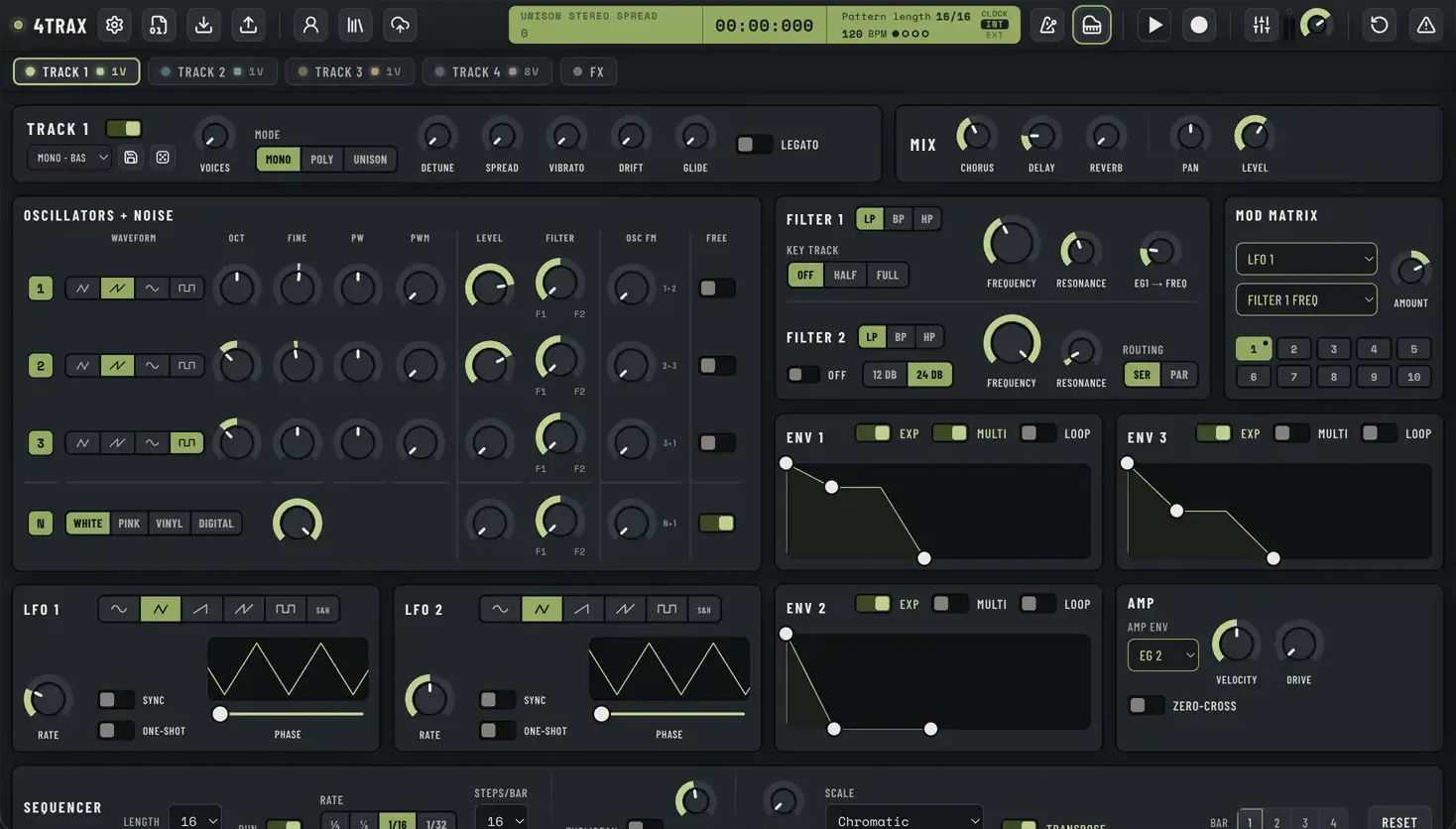
The 4TRAX panel: three oscillators and a noise source per track, two filters, three envelopes, two LFOs and a ten-slot mod matrix

4TRAX

Your free Four-track subtractive groovebox. Multitimbral, MIDI-mappable and records its own stems. Load it and press play for a demo.

01

Classic, subtractive synthesis

Three oscillators and a noise source, per track. Each oscillator carries a waveform, octave, fine tune, pulse width with its own PWM, level, and a switch picking which filter it feeds. Cross-modulate one into the next with OSC FM and the sawtooth starts to snarl.

Free-run phase is a switch, not an afterthought. Turn it off and every note starts at the same point in the cycle — which is the difference between a kick drum and a kick drum that sometimes shows up.

The noise source has four flavours — white, pink, vinyl and digital — with its own pitch and keytracking, so it tunes with the patch instead of sitting on top of it.
02

The 24 dB ladder filter you love

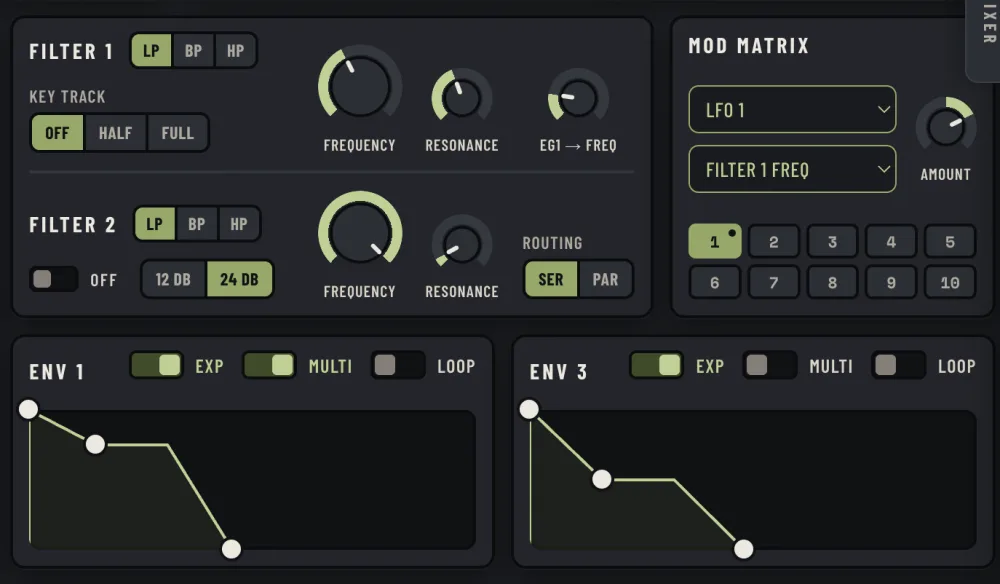
Two filters per track. Filter 1 has cutoff, resonance, keytracking and a modulation slot of its own. Filter 2 switches in behind it with a selectable slope, and the pair runs in series or in parallel — every oscillator chooses which one it feeds, or both.

The 24 dB transistor ladder is the one you already know from every acid line and every fat bass ever printed: resonance that thickens instead of thinning, and a self-oscillation you can play as a sine.

It is built from the circuit topology rather than curve-fitted to a recording, and runs 2× oversampled, so the resonance stays sweet up top where a naive filter fizzes.

The 4TRAX filter section and mod matrix
03

Extensive modulation

Three ADSR envelopes with curves you drag by hand, each switchable to exponential, to Multi (retrigger on every note, even legato) or to Loop. Env 2 drives the amp, Env 1 usually takes the filter, Env 3 is yours to spend.

Two LFOs — six shapes including sample & hold — with phase and a one-shot mode, running free in hertz or locked to the tempo as a ratio.

Then the mod matrix: ten slots per track, each a source, a destination and an amount. Sources are the LFOs and the envelopes; destinations run through pitch, both filters, pan, levels and most of what is on the panel. Ten per track is forty across the machine, all live at once.

04

That J chorus, tape delay and a massive verb

Three send effects, shared by all four tracks, each track deciding how much to send.

The chorus is the two-mode ensemble you are thinking of: I for a shimmer, II for the wide one on every record you own.

The delay locks to the tempo or runs free, with modulation speed and depth on the delay line — push them and it wobbles like tape that has seen some things.

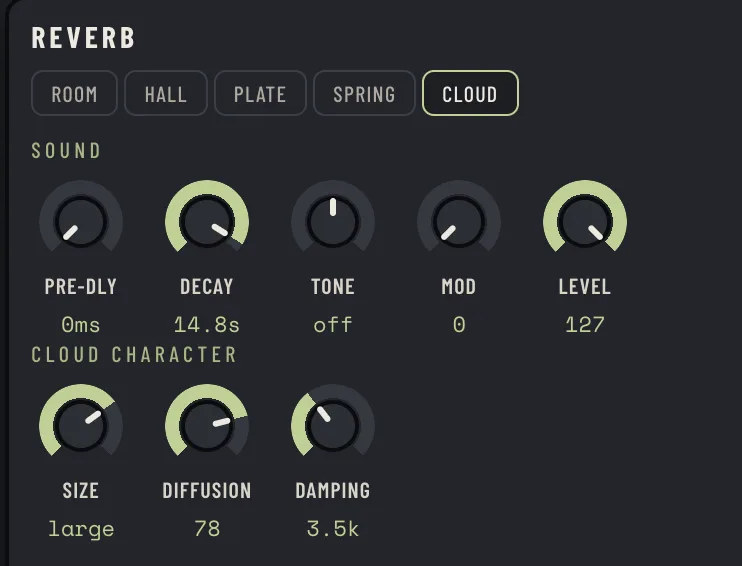
The reverb is five separate machines behind five tabs: Room, Hall, Plate, Spring and Cloud. A shared spine of pre-delay, decay with a live RT60 readout, tone and mod, plus whatever that flavour does that the others don't. Nothing hides behind a fold-out — every parameter is out on the panel.

The 4TRAX reverb page with its five flavours
05

Swedish style sequencer with all that

Four lanes, up to 64 steps each, one bar in view at a time. Every track keeps its own rate — ¼ down to 1/32 — and its own length, which is where it gets interesting. A 4-step bass against a 16-step hat locks tight; a 12-step lane against a 16 drifts through phases and comes back together at the bar. That is polymeter, and here it is a switch rather than a trick.

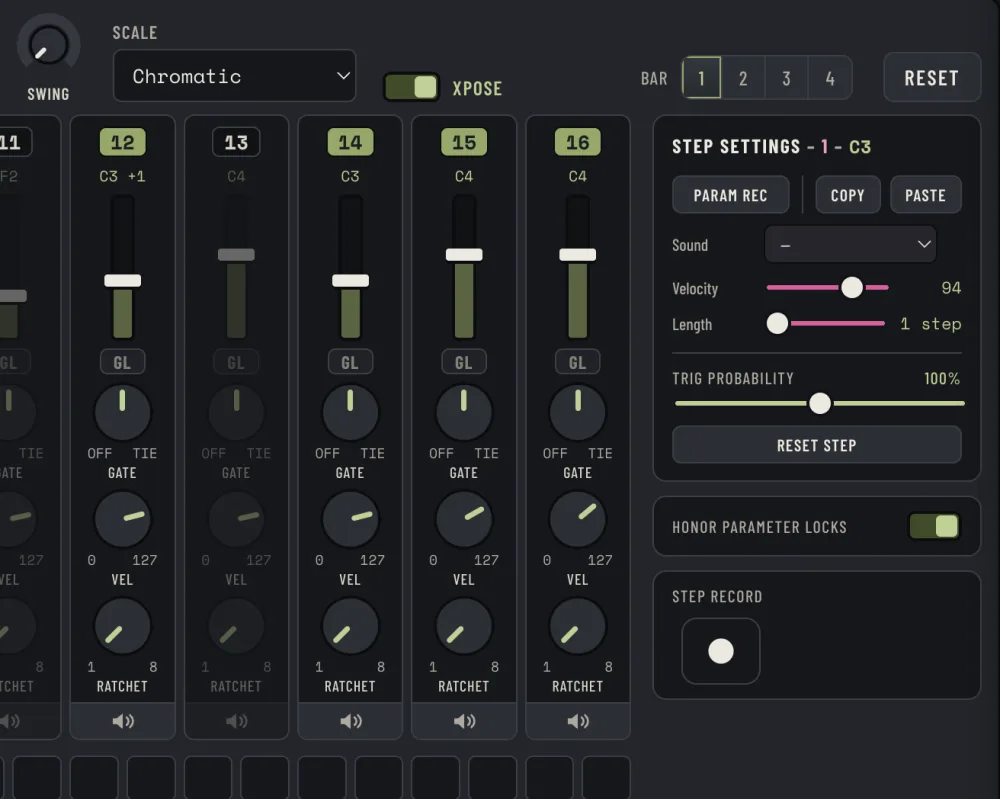
Per step: velocity, length, ratchet, glide, trig probability, and an A:B condition that counts that lane's own passes so fills land where you expect. Chords sit on a single step.

Parameter locks on any knob. Sound locks to swap the whole patch for one step. Swing on the real 50–80% scale, stepping in whole percent — so a groove you like is a number you can write down.

The 4TRAX step sequencer with parameter locks and the trance gate lane
06

MIDI mapping and Auto-channel

Each track listens on its own MIDI channel, so one keyboard drives four instruments. The auto channel always plays whichever track you are looking at — plug in, play, no menu diving.

Press Map and every control on the panel shows its CC number. Learn one by moving it, save the whole map as a file, load it on another machine.

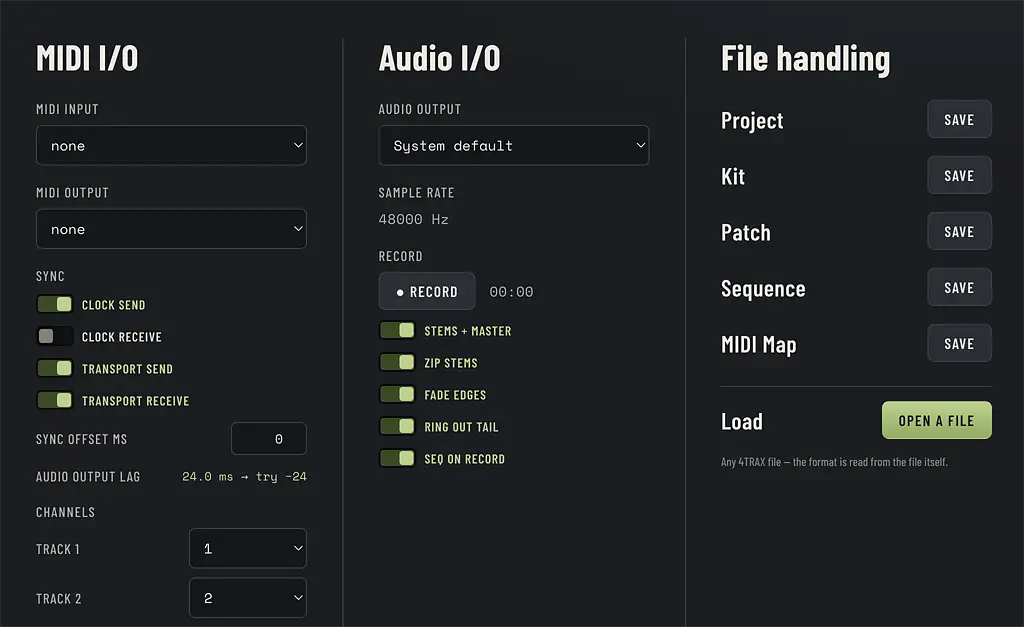
4TRAX sends MIDI clock and transport to your hardware, or slaves to it — tight and drift-free, with a ±200 ms offset to nudge the grid against gear that runs early — enough to cover your interface's output latency, which the page shows you. While slaved the tempo knob locks, because the master owns tempo.

The 4TRAX System page: MIDI I/O with clock and transport sync, the sync offset and per-track channels, beside Audio I/O and file handling
07

Mixer and audio recorder with stems

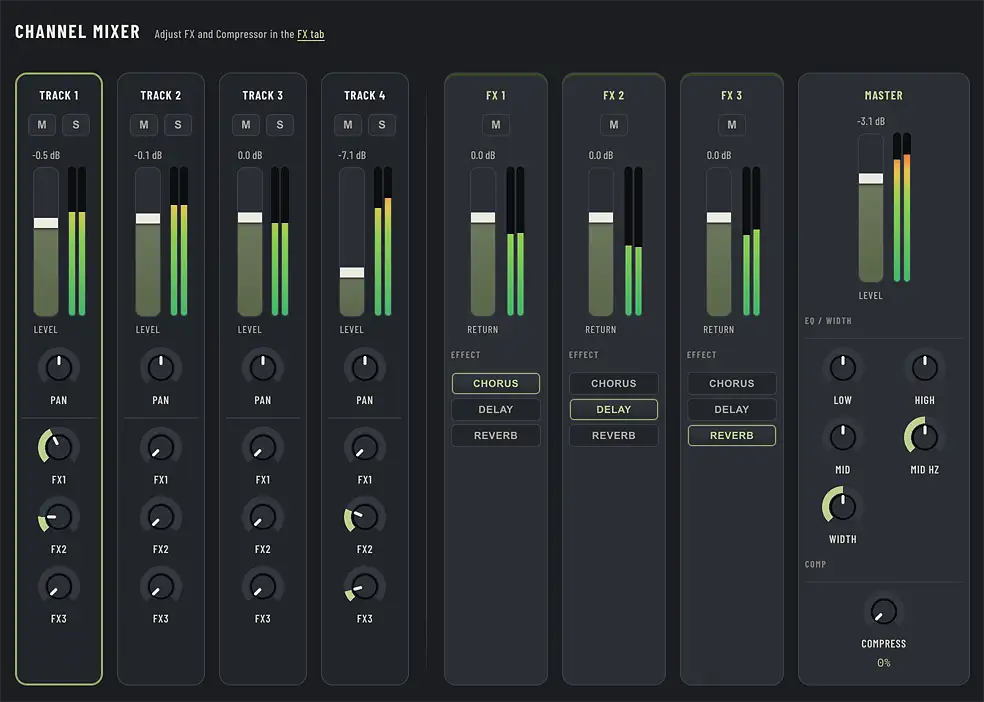
A fold-out mixer with a strip per track: fader in dB, post-fader meter, pan and the three sends. The aux returns sit beside them, then a master strip with EQ, stereo width, the bus compressor and the fader.

That compressor is the console-style one — feedback detector, mono-summed key, ratios up to 10:1, sidechain HPF, and a Key selector so any track can duck the whole mix. Autopump stamps a ready-made pump keyed off whatever you point it at, and touching any control by hand hands it straight back to you.

Hit record and you get a 16-bit WAV of the master. Turn on stems and you get one file per track plus the master, zipped, with the tail rung out properly instead of chopped at the bar line.

The 4TRAX channel mixer: four track strips with meters, pan and three sends, the FX return strips, and the master strip with EQ, width and the bus compressor
08

Community patch and song library

A shared shelf of sounds and songs built by whoever shows up. Browsing costs nothing and changes nothing: preview auditions a sound on the selected track and puts yours straight back, and clicking a shared song plays it without touching your project.

Sharing needs a name to put on things, so you pick a three-letter tag and a vibe — Geek, Goth, Zen, Punk. That is the entire signup. No email, no password; they live in this browser.

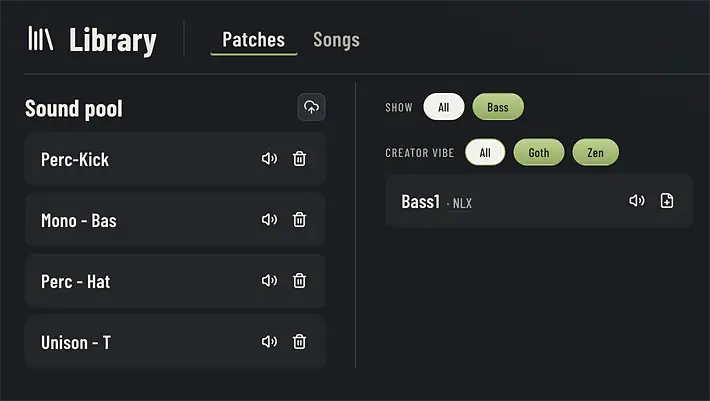
Tags are deliberately not unique. There can be fifty creators called NLX and any number of patches called Bass1, exactly like a wall of cassettes — 4TRAX tells them apart behind the scenes. Sharing is one-way and permanent, and the page tells you that before you press it, not after.

The 4TRAX Library: your own sound pool on the left, shared patches filtered by tag and creator vibe on the right
The numbers

Technical specifications

Per track

  • Oscillators 3 + noise
  • Waveforms tri · saw · sine · square
  • Noise types white · pink · vinyl · digital
  • Cross-modulation OSC FM, 1→2→3
  • Filters 2 · LP / BP / HP
  • Filter 2 slope 12 or 24 dB
  • Filter routing series or parallel
  • Envelopes 3 × ADSR, drawable
  • LFOs 2 × 6 shapes
  • Mod matrix 10 slots
  • Voices 1–8
  • Voice modes mono · poly · unison
  • Sequencer lane up to 64 steps
  • Step rates ¼ · ⅛ · 1/16 · 1/32
  • Swing 50–80%, 1% steps

Recommended system

  • Install none
  • Account none
  • Browser any current browser
  • Engine Web Audio + AudioWorklet
  • MIDI hardware needs Web MIDI (Chrome / Edge)
  • Processor any Apple Silicon, or recent x86
  • Memory 8 GB comfortable
  • Screen 1470 × 900 or wider
  • Touch works, mouse is better
  • Headphones strongly recommended
  • Network to load the page and the Library
  • Offline keep the page, it still runs
  • Disk space your saved files only
  • Cookies none set
  • Analytics none, ever

Audio

  • Internal processing 32-bit float
  • Sample rate follows your device
  • Filter oversampling
  • Polyphony up to 8 per track
  • Send effects chorus · delay · reverb
  • Reverb algorithms room · hall · plate · spring · cloud
  • Delay tempo-synced or free
  • Bus comp ratios 1.5 · 2 · 3 · 4 · 5 · 10
  • Sidechain HPF off · 30 · 60 · 105 · 125 · 185 Hz
  • Master bus EQ · width · comp · limiter
  • Recording 16-bit WAV
  • Stems one per track + master, zipped
  • MIDI clock send and receive
  • Sync offset ±200 ms
  • File types .itsaall · .itsakit · .itsapatch · .itsaseq · .itsamap

Everything else

  • The manual is a single offline page covering every function in sixteen short chapters — the same file that ships inside the instrument, so it works with no connection at all.
  • Nothing here expires, phones home, or asks who you are. If you want to keep 4TRAX forever, save the page: it is one HTML file and it runs from your desktop.

It is already loaded with a song.

Press play, then start breaking it. Nothing to install, nothing to sign, nothing to cancel later.